
Planning an RV solar system for Alberta: energy audit, panels, batteries and controller
Start with what you use, not with panels. An honest energy audit tells you battery size; your season and location tell you panel size. In an Alberta December, flat roof panels make only a small fraction of their July output, so plan accordingly.
Recommended tools & parts for this job

Batteries & inverters
Smart battery shunt (Bluetooth)
Measures every amp in and out so you know real state of charge, not just voltage.
Check price on Amazon.ca
Electrical & testing
Clamp meter (AC/DC current)
Measures current draw without breaking the circuit, handy for converter, solar and A/C checks.
Check price on Amazon.ca
Batteries & inverters
12V LiFePO4 (lithium) deep-cycle battery
Lighter with more usable capacity than lead-acid. Most can't be charged below freezing unless they have built-in heating, so check the spec and your charger's lithium profile.
Check price on Amazon.ca
Solar
MPPT solar charge controller
Converts higher panel voltage into charging current. The best choice for series strings and cold, bright days.
Check price on Amazon.ca
Solar
Rigid roof-mount solar panel kit (panels, mounts, controller)
The most durable option for roof installs. Plan your system first.
Check price on Amazon.caSolar
Portable folding solar panel (solar suitcase)
Park in shade and put the panel in the sun.
Check price on Amazon.caAs an Amazon Associate I earn from qualifying purchases. Always confirm part numbers and sizes against your RV or appliance model before ordering. See all recommended RV tools & parts →
Start with an energy audit
Every good solar system starts with one number: how many watt-hours (Wh) you use per day. Panels, batteries and controllers are all sized from it.
- List everything that runs on 12V or through an inverter: lights, water pump, furnace fan, fridge (if 12V or on an inverter), fans, phone and laptop charging, TV, CPAP, coffee maker and so on.
- Find each item's power in watts (W) on its label or in its manual. If only amps are listed, multiply amps × volts (12V items: amps × 12; 120V items: amps × 120).
- Estimate hours per day each one runs.
- Multiply watts × hours for each item, then add them up to get Wh per day.
- For anything running through an inverter, add roughly 10 to 15% for inverter losses (check your inverter's efficiency rating).
The best way to get real numbers is to measure. A battery monitor with a shunt shows exactly how many amp-hours leave your battery in a day of normal use. A DC clamp meter can measure individual circuits.
| Example item (use your own figures) | Watts | Hours/day | Wh/day |
|---|---|---|---|
| LED lights | 20 | 4 | 80 |
| Water pump | 60 | 0.5 | 30 |
| Furnace blower (winter) | 40 | 6 | 240 |
| Phones and laptop (via inverter) | 70 | 2 | 140 |
| Vent fan | 25 | 6 | 150 |
| Example total | 640 |
These are made-up example values to show the math. Your RV will be different.
Tip: The furnace blower is often the biggest 12V load in Alberta's shoulder seasons. On cold nights it can be your largest single draw, more than lights and electronics combined.
Size the battery bank
Convert your daily Wh into amp-hours (Ah) at your battery voltage: Ah = Wh ÷ battery voltage. Using the example, 640 Wh ÷ 12 V ≈ 53 Ah per day.
Then decide:
- How much of the battery you can use. Lead-acid batteries (flooded and AGM) last much longer if you avoid deep discharges. Many manufacturers suggest using only about half the rated capacity. Lithium iron phosphate (LiFePO4) batteries allow most of their rated capacity to be used. Check your battery's specifications.
- Days of autonomy. How many cloudy days you want to get through without sun or a generator. One to three days is a common choice.
Battery Ah needed = daily Ah × days of autonomy ÷ usable fraction.
Example: 53 Ah × 2 days ÷ 0.5 (lead-acid) ≈ 212 Ah of lead-acid, or 53 × 2 ÷ 0.9 ≈ 118 Ah of LiFePO4 if the manufacturer allows about 90% use.
Alberta: Most LiFePO4 batteries must not be charged below about 0 °C unless they have built-in heating or are kept in a heated space. Check the charge temperature limit on the spec sheet. A self-heating lithium battery or keeping the battery inside the heated living space helps for shoulder-season camping.
Size the solar array using real Alberta data
Natural Resources Canada (NRCan) publishes photovoltaic potential for Canadian municipalities: the kilowatt-hours a system produces per kilowatt of panels (kWh/kWp), per month, for different panel angles. Most RV panels lie flat on the roof, so the horizontal figures are the ones that matter for roof-mounted systems.
| NRCan PV potential (kWh per kWp, per month) | Calgary, flat (horizontal) | Calgary, tilted (latitude +15°) | Edmonton, flat (horizontal) |
|---|---|---|---|
| January | 27 | 83 | 22 |
| March | 82 | 120 | 80 |
| June | 139 | 105 | 138 |
| July | 149 | 114 | 142 |
| September | 83 | 112 | 76 |
| November | 28 | 81 | 24 |
| December | 21 | 71 | 17 |
| Annual | 996 | 1,228 | 944 |
Source: Natural Resources Canada, Photovoltaic potential and solar resource maps of Canada, municipality database (accessed October 2026). NRCan's figures are for grid-connected systems and already include a 0.75 performance ratio for typical losses. Treat them as planning estimates.
To turn these into a daily figure, divide the monthly number by the days in the month. In Calgary in July, flat panels make about 149 ÷ 31 ≈ 4.8 Wh per watt of panel per day. In December that drops to about 21 ÷ 31 ≈ 0.7 Wh per watt per day.
Panel watts needed ≈ daily Wh ÷ (Wh per watt per day for your month), plus a margin for battery charging losses, dirt and partial shade. Adding 20 to 25% is a reasonable starting point.
Example, 640 Wh per day:
- July in Calgary, flat: 640 ÷ 4.8 ≈ 133 W, so about 170 W with margin.
- December in Calgary, flat: 640 ÷ 0.7 ≈ 914 W, so well over 1,100 W with margin, which won't fit on most RV roofs.
That's the key lesson for Alberta: flat roof solar is a spring-to-fall system. In winter, low sun, short days and snow cover mean you'll rely on shore power, a generator or a DC-DC charger from the vehicle.
Tip: Tilt makes a big difference in winter. NRCan's Calgary December figure for panels tilted at latitude +15° is 71 kWh/kWp, more than three times the flat-panel figure. A portable suitcase panel propped up and aimed south, or tilting roof mounts, can greatly improve winter harvest. Always brush off snow and frost.
Size the charge controller
- Output current: roughly array watts ÷ battery voltage, plus about 25% headroom. Example: 400 W ÷ 12 V ≈ 33 A, so choose a 40 A controller or larger.
- Input voltage: with an MPPT controller, the array's open-circuit voltage (Voc) in the coldest weather must stay below the controller's maximum PV input voltage. Panel voltage rises as temperature drops, which matters in Alberta. The math is in Wiring RV solar panels in series, parallel or series-parallel.
- MPPT or PWM: MPPT controllers can use higher-voltage strings and usually harvest more energy, especially in cold, bright weather. PWM controllers are cheaper and work for small systems with 12V-nominal panels wired in parallel.
- Battery profile: make sure the controller has a charging profile for your battery chemistry (lead-acid, AGM or lithium), and ideally low-temperature charge protection for lithium.
Size the inverter
Add up the watts of everything that might run at the same time on 120V through the inverter, then choose an inverter whose continuous rating exceeds it, with surge capacity for motors and compressors. A pure sine wave inverter is the safe choice for electronics, CPAP machines and appliances.
Remember that big 120V loads drain batteries fast. A 1,500 W hair dryer or kettle draws well over 100 A from a 12V battery while it runs. Air conditioners, electric heaters and electric water heater elements are generally impractical on typical RV battery banks.
Inverter installation is covered in Installing an RV inverter and automatic transfer switch.
Put it together
- Energy audit: Wh per day for the season you camp.
- Battery: daily Ah × days of autonomy ÷ usable fraction.
- Panels: daily Wh ÷ Wh per watt per day for your worst planned month, plus margin, and check roof space.
- Controller: current from array watts, voltage from cold-weather Voc.
- Inverter: continuous and surge watts for loads that run together.
- Protection: fuses, breakers and grounding, covered in RV solar and battery fusing, breakers, grounding and safety.
When to call a pro
Planning is DIY-friendly. Get help from a qualified RV electrical technician or licensed electrician if you're adding lithium batteries to an existing system with a converter or alternator charging, if your plan involves the 120V AC panel or a transfer switch, or if you're not sure about wire and fuse sizing.
Related guides
How-to videos

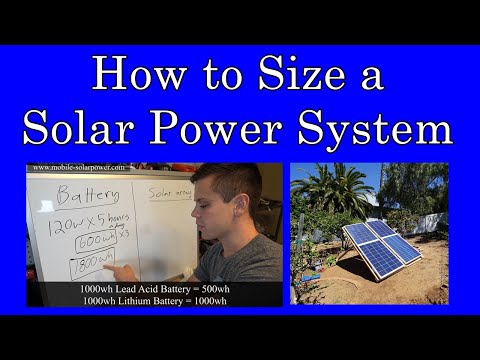
Videos are made by third-party creators and load from youtube-nocookie.com only when you press play. Models differ, so always follow your own manuals and the safety notes on this page.
Disclaimer: This guide is general information based on common RV designs. Models differ, so check your owner's manual and appliance manuals. Propane, 120V electrical and brake systems can cause serious injury if handled incorrectly. If you are unsure, stop and book a certified RV technician.